A compact and flexible surge protection solution for North American LED lamps and drivers
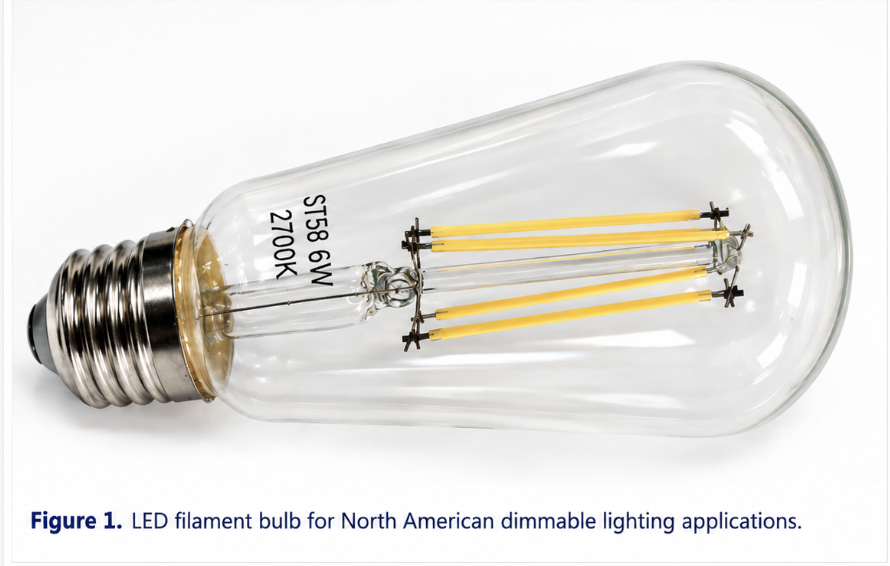
Introduction
Surge protection is an important part of LED lighting design, especially for dimmable LED lamps in North America.
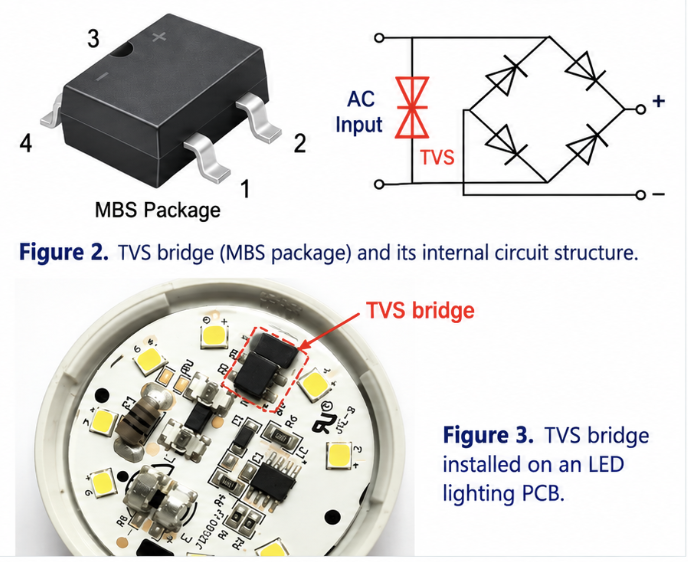
Many LED drivers use an integrated TVS bridge to provide both rectification and transient voltage protection. This design is compact and convenient, but it can also limit component selection and increase dependence on a single supplier.
Boarden offers an alternative solution using high-energy CMS multilayer SMD varistors.
Instead of relying on an integrated TVS bridge, manufacturers can use a separate rectifier bridge and CMS varistors for surge protection.
This approach provides greater flexibility in circuit design, component selection, and supply chain management.
In this article, we explain how Boarden CMS varistors can be used in 120 VAC dimmable LED lighting applications, including LED filament bulbs, LED lamps, and linear lighting modules.
1. Why Replace a TVS Bridge with CMS Varistors?
A TVS bridge combines two functions in one package:
- Rectification: Converting AC voltage into DC voltage.
- Surge protection: Limiting transient overvoltage to protect electronic components.
Although this integrated design reduces component count, it also creates limitations.
For example, if an LED manufacturer wants to improve surge protection performance, the entire TVS bridge may need to be replaced.
With Boarden’s CMS solution, these functions are separated.
A standard rectifier bridge handles AC-to-DC conversion, while CMS SMD varistors provide surge protection.
This design offers several potential advantages:
- Flexible component selection: Engineers can choose the rectifier and protection devices independently.
- Improved supply flexibility: Manufacturers are less dependent on a specific integrated TVS bridge.
- Compact SMD design: CMS varistors support automated PCB assembly.
- Circuit optimization: Surge protection can be adjusted for different LED driver designs.
- Potential cost savings: Independent components may offer more sourcing and design options.
The CMS varistor does not replace the rectifier itself. It replaces the transient suppression function of the integrated TVS bridge.
2. How Boarden CMS Varistors Protect LED Drivers
Boarden CMS varistors use multilayer zinc oxide (ZnO) technology.
During normal operation, the varistor maintains high resistance and has little effect on the circuit.
When a surge occurs, its resistance drops rapidly, allowing transient current to flow through the protection path.
This helps limit the voltage reaching sensitive components.
Compared with conventional TVS diode solutions, selected CMS varistors can offer advantages in bidirectional surge protection, compact construction, and surge current handling capability.
However, actual performance depends on the specific part number and circuit conditions.
CMS Varistors vs. TVS Diodes
| Feature | Boarden CMS Varistor | TVS Diode |
|---|---|---|
| Technology | Multilayer ZnO ceramic | Semiconductor PN junction |
| Protection direction | Bidirectional | Unidirectional or bidirectional |
| Surge capability | High-energy options available | Depends on pulse power and package |
| Temperature performance | Depends on CMS series and ratings | Depends on junction temperature and derating |
| Main application | Surge energy diversion and voltage clamping | Transient voltage clamping |
The key advantage of CMS is the ability to provide surge protection in a compact surface-mount package while allowing greater flexibility in circuit design.
3. Two-Stage Surge Protection for 120 VAC LED Lighting
For North American dimmable LED lighting, Boarden proposes a two-stage protection design using CMS varistors at two different circuit locations.
The first varistor protects the AC input, while the second provides additional protection near the LED driver IC.
VR1: Input Surge Protection
VR1 is installed across the AC input, before the rectifier bridge.
Its main function is to absorb differential-mode surge energy and reduce the transient voltage entering the driver circuit.
A fusible resistor or surge-limiting resistor can also be used to help control surge current and provide fault protection.
VR2: LED Driver IC Protection
VR2 is installed near a sensitive high-voltage node of the LED driver IC.
Its purpose is to limit residual voltage spikes that remain after the first protection stage.
This provides an additional layer of protection for the driver IC and related components.
Why Use Two Protection Stages?
The two CMS varistors perform different functions.
VR1 handles incoming surge stress, while VR2 helps protect sensitive downstream circuitry.
When properly selected and coordinated, this arrangement can improve the overall surge protection design.
[Insert Image 3: Two-stage CMS surge protection schematic showing VR1 and VR2]
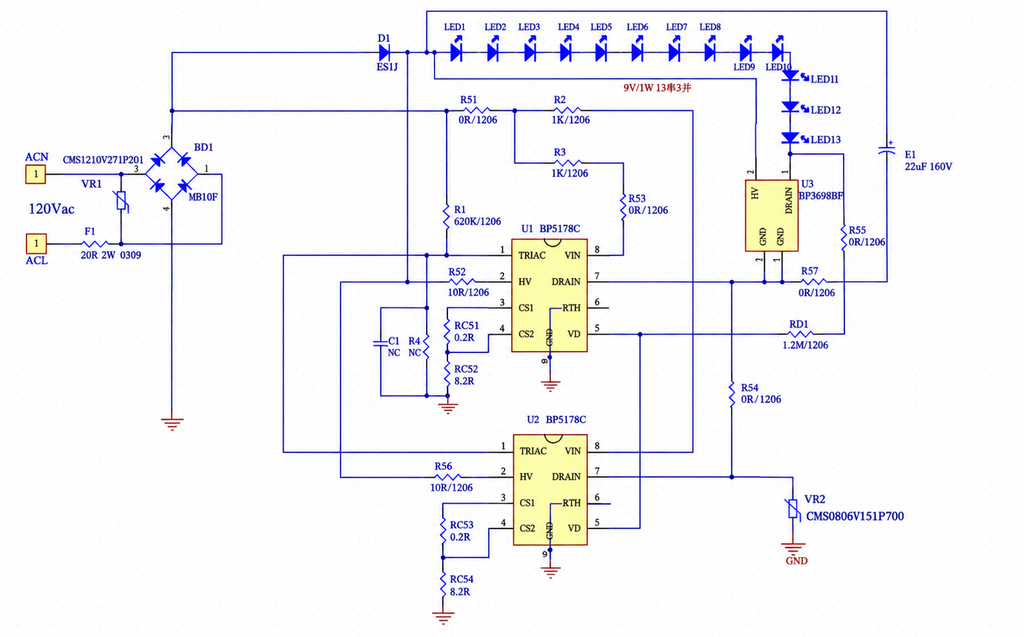
Figure 4. Two-stage surge protection using Boarden CMS varistors in a 120 VAC dimmable LED driver.
4. Recommended CMS Models and Surge Testing
The following CMS models are candidates for a North American dimmable LED lighting project.
Application Requirements
| Parameter | Project Requirement |
|---|---|
| Input voltage | 120 VAC |
| Maximum power | 25 W |
| Power factor | ≥0.7 |
| Ring wave test target | 2.5 kV |
| Series protection resistor | 4.7–47 Ω, 2 W |
Recommended CMS Models
VR1 — Input Protection
- CMS0604V241P500
- CMS0604V271P500
- CMS0806P241P101
- CMS0806P271P151
VR2 — Driver IC Protection
- CMS0806V151P700
- CMS0604V151P500
- CMS0806V101P201
- CMS0604V101P101
These models are proposed for evaluation. Final selection must be based on the product datasheet and actual circuit testing.
Ring Wave Surge Testing
Ring wave testing is commonly used to evaluate how electronic equipment responds to oscillating voltage transients.
IEC 61000-4-12 provides a standardized method for ring wave immunity testing.
For this lighting project, the proposed test conditions include:
- Initial test voltage: 2.5 kV.
- Source impedance: approximately 30 Ω.
- Positive and negative surge polarity.
- Ten surges per polarity.
- Additional voltage steps of 500 V for design-limit evaluation.
These are project-specific test conditions. The final test procedure should follow the applicable customer requirements.
A successful test should confirm that the LED lamp continues to operate normally and that the protection components remain within acceptable electrical limits.
Line Noise Compatibility
Dimmable LED drivers may also need to pass customer-specific line noise tests.
These tests are different from ring wave testing and may involve high-frequency disturbances or other electrical noise.
The CMS protection design should therefore be evaluated for both surge protection and normal dimming performance.
5. Reliability and Benefits for LED Manufacturers
For LED lighting manufacturers, surge protection is not only about passing a single laboratory test.
A reliable design must also perform consistently during production and long-term operation.
Before adopting a CMS-based protection solution, engineers should verify:
- Surge performance under the required test conditions.
- Clamping voltage at sensitive circuit nodes.
- Leakage current and temperature performance.
- Repeated surge capability.
- Compatibility with TRIAC dimming.
- Safe operation under component fault conditions.
These tests help confirm whether the solution is suitable for mass production.
Why Choose Boarden CMS?
Boarden CMS multilayer SMD varistors offer a practical option for LED manufacturers seeking to optimize their protection circuits.
By separating rectification and surge protection, manufacturers gain more freedom to select components and adapt the same design approach to different lighting applications.
The potential benefits include compact SMD assembly, flexible component sourcing, coordinated surge protection, and improved opportunities for circuit optimization.
Conclusion
Replacing an integrated TVS bridge with a separate rectifier and Boarden CMS varistors is a flexible approach to LED driver surge protection.
For North American 120 VAC dimmable LED lighting, a two-stage CMS design can help protect both the AC input and sensitive driver IC circuitry.
With proper component selection and circuit testing, this solution offers manufacturers an alternative to conventional integrated TVS bridge designs.
Looking for a surge protection solution for your LED lighting products?
Shanghai Boarden Industrial Co., Ltd. provides CMS multilayer SMD varistors and technical support for LED drivers, dimmable lamps, and other power electronics applications.
Contact us to discuss your circuit requirements or request CMS samples.
Website: https://shboarden.com
Technical References
- IEC 61000-4-12:2017 — Ring Wave Immunity Test.
- U.S. EPA — ENERGY STAR Lamps Version 2.1.
- U.S. EPA — ENERGY STAR Lighting Sunset.
- TDK Electronics — Multilayer Varistors Technical Overview.
- Shanghai Boarden Industrial Co., Ltd. — CMS TVS Bridge Replacement Project Technical Records.